What is 'digital assessment'?

...and how can RM help you do it well?

What do we mean by “digital assessment”?

 Across awarding organisations, exam boards, governments and education providers, “digital assessment” has become a central part of modernising qualifications and exams. Yet the term can mean different things to different teams. At its simplest, digital assessment is any assessment where key stages of the process are supported or delivered using digital technology rather than relying solely on traditional, fully manual approaches.

We will set out a clear definition of digital assessment, explore the main models in use today, and show you how RM supports organisations to deliver secure, scalable and fair digital assessments across programmes and geographies. 

In practice, digital assessment involves one or more of the following:

Digital assessment is not a single product. It is a set of processes, supported by technologies and people, that together create a more secure, efficient and transparent assessment lifecycle.

A guide to our digital assessment platform

A smarter way to create, deliver and manage assessment. We support the assessment lifecycle from building exam content and e-testing through to marking and feedback. This creates a seamless way for you to work and a brilliant experience for your candidates.

Use the platform RM Ava, to manage the entire journey or choose specific modules for e-marking or e-testing.

Key components of digital assessment

Although assessment models vary between organisations and awarding bodies, most digital assessment platforms draw on some or all of these components:

Digital exam authoring and item banking

Assessment content is created, reviewed and stored within secure item banking tools. This can support:

  • Collaborative authoring and review
  • Version control and approvals
  • Item-level metadata (for example, curriculum links, difficulty, skills tested)
  • Safer and more efficient test assembly

Onscreen or computer-based delivery

Candidates complete assessments using digital devices in test centres, schools, universities or remote locations. This can enable:

  • Richer question types (for example, drag-and-drop, simulations, spreadsheets)
  • More flexible scheduling and resits
  • Tailored or adaptive pathways in some assessment models
  • Immediate capture of responses for marking and analysis

E-marking and onscreen marking

Markers view and mark responses digitally. This can be applied to:

  • Natively digital responses (typed, selected or uploaded work)
  • Scanned images of handwritten scripts
  • Supporting evidence such as uploaded files or recording
  • E-marking allows organisations to apply consistent marking schemes, sampling, double marking or moderation workflows, while capturing detailed data on marker performance and item performance.

Assessment integrity and security

Digital assessment introduces new opportunities – and new responsibilities – for maintaining assessment integrity. Effective digital programmes embed:

  • Secure candidate authentication and access
  • Controlled test environments
  • Item exposure control and randomisation
  • Monitoring, audit trails and reporting for quality assurance

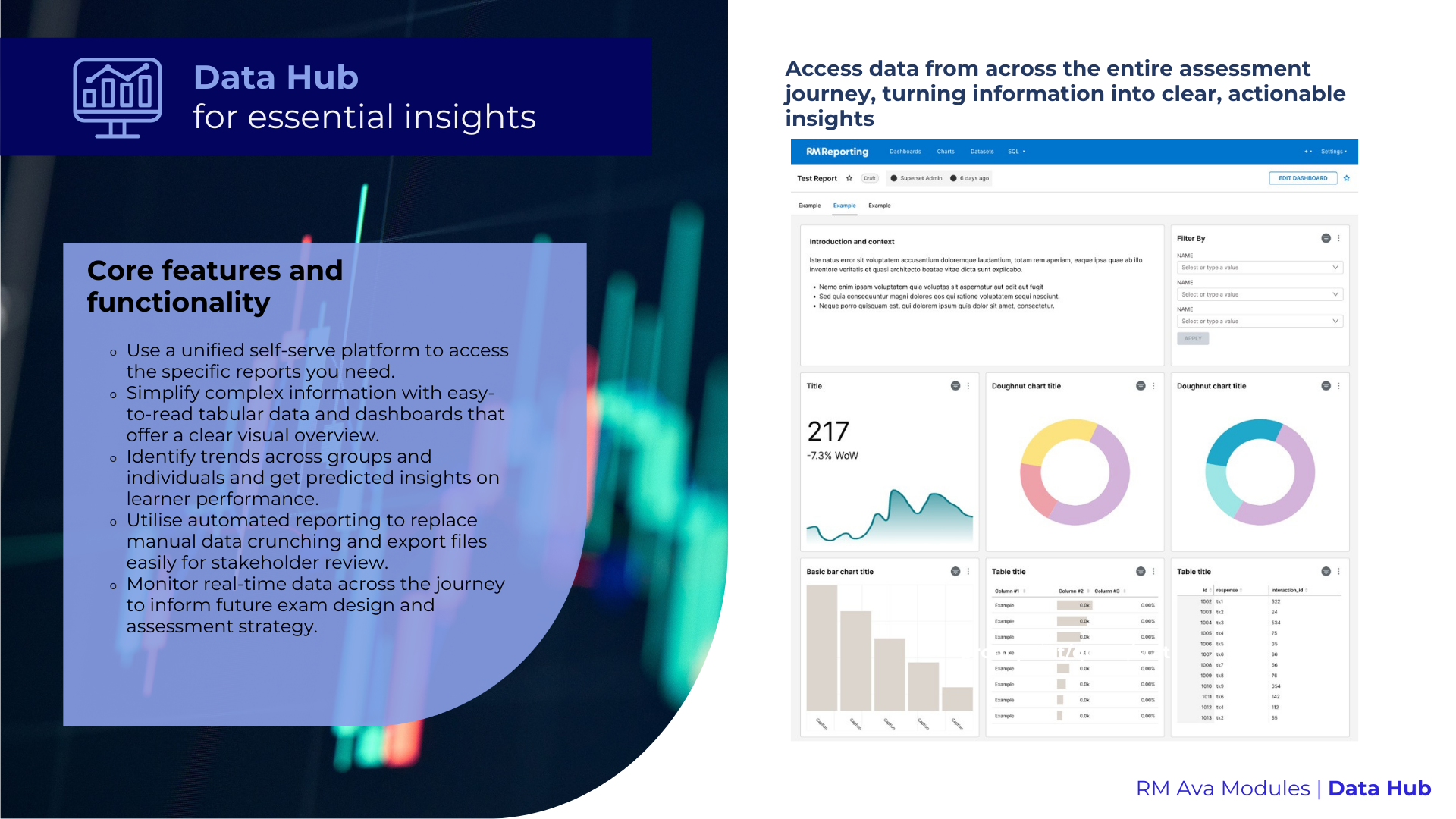
Analytics, insights and reporting

Because digital assessment captures data at item and process level, it can support:

  • Richer analysis of item performance and reliability
  • Insight into marking quality and consistency
  • Faster, more transparent reporting to institutions, regulators and candidates

Why organisations are moving to digital assessment

Different organisations start from different points, but many share similar goals.

Well-designed digital assessment can support a more consistent, accessible candidate journey.

Modernisation and scalability

National assessment bodies, large awarding organisations and professional bodies often need to:

  • Deliver high volumes of assessments across multiple regions or time zones
  • Support flexible windows or on demand models
  • Introduce new formats that reflect modern curricula and workplace practice
Digital assessment supports these ambitions more effectively than fully manual processes.

Security and integrity

Maintaining public trust is essential for high-stakes assessment. Digital assessment, implemented carefully, can:

  • Improve control over content access and distribution
  • Provide robust monitoring and audit logs
  • Support approaches to malpractice prevention that combine technology with human oversight

Marking quality and efficiency

E-marking and digital workflows can:

  • Help organisations improve marking consistency and transparency
  • Provide earlier visibility of potential issues during marking
  • Reduce turnaround times for results, within a controlled quality framework

Candidate experience and accessibility

Candidates increasingly expect assessment experiences that:

  • Reflect the digital tools they use in learning and work
  • Are accessible to candidates with a broad range of needs
  • Minimise unnecessary stress related to unfamiliar processes

Ready to modernise your assessments?

Whether you're scaling globally, refining quality, or just starting your digital journey, we're here to help you get it right - with technology, expertise and outcomes you can trust.