What is 'e-marking'?

...and how can RM help you do it well?

What do we mean by “e-marking”?

Across awarding organisations, exam boards, professional bodies and education providers, e-marking has become an important part of delivering modern assessment at scale. Yet the term is still sometimes misunderstood.

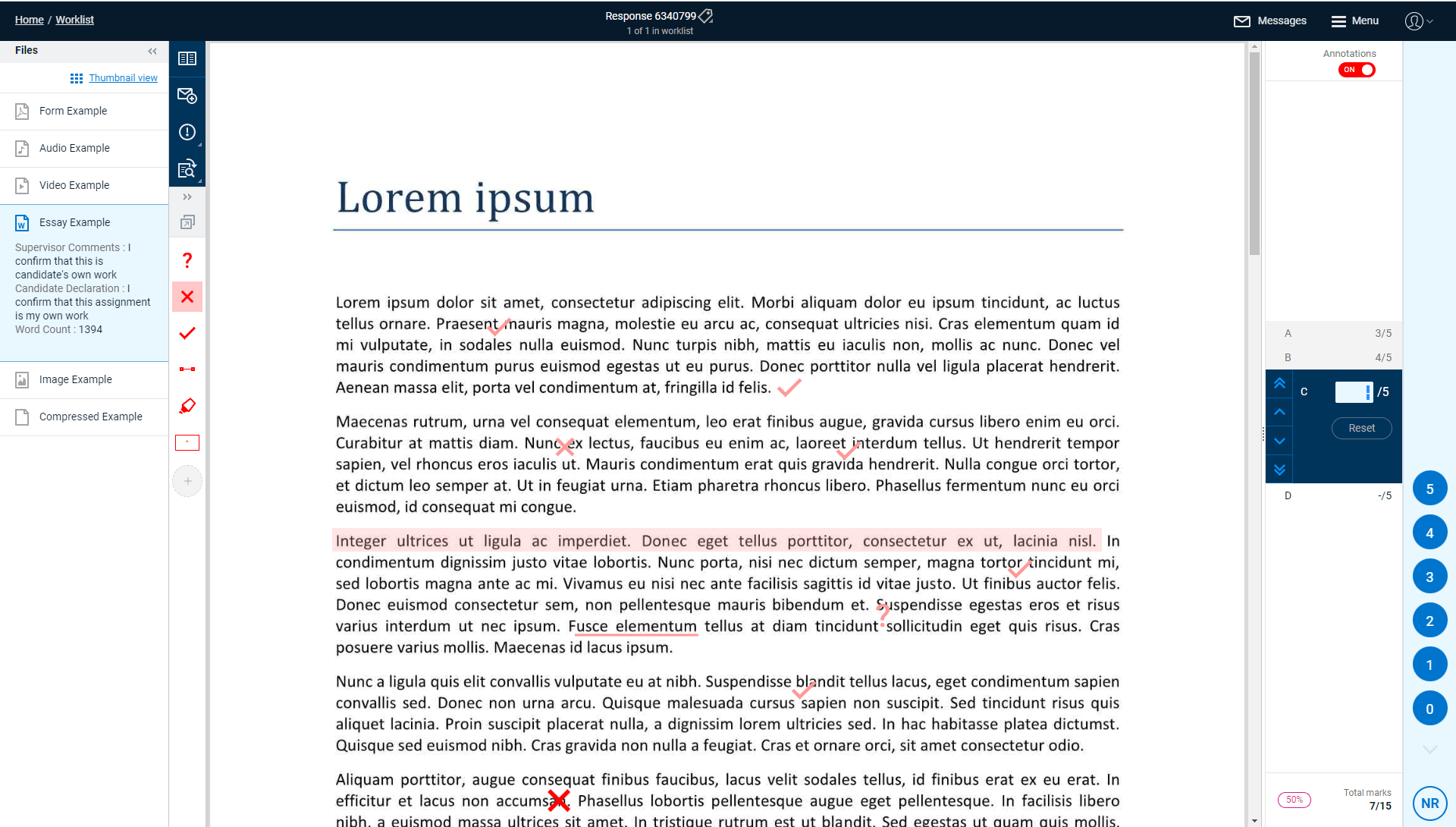
At its simplest, e-marking is the process of marking assessment responses digitally rather than relying solely on manual, paper-based marking workflows. This does not always mean candidates must sit exams digitally. In many models, candidates may still write responses by hand on paper, with scripts then scanned and marked onscreen by examiners. In other models, responses are completed and marked entirely within digital platforms.

We will define e-marking clearly, explain how it works in practice, and show how RM helps organisations deliver secure, scalable and fair marking processes that support quality, efficiency and assessment integrity.

In practice, e-marking involves one or more of the following:

E-marking is not simply a way to replace paper with screens

It is a more structured marking process that helps organisations improve consistency, visibility and control while supporting examiners with better tools and clearer workflows.

A guide to our e-marking solution

RM supports organisations with e-marking solutions designed to help them mark accurately, securely and efficiently across a wide range of assessment models.

Using RM Assessor, organisations can mark scanned handwritten scripts, digital responses and other assessment evidence within a secure environment built for quality-controlled marking.

Whether you are modernising an existing paper-based process or building a broader digital assessment model, e-marking can be introduced in ways that align with your operational needs, candidate requirements and quality standards.

Key components of e-marking

Onscreen marking of handwritten or digital responses

E-marking can be used for:

  • Scanned handwritten exam scripts
  • Typed responses from digital assessments
  • Coursework and uploaded files
  • Audio, visual or other supporting evidence where relevant

Marking quality and consistency

A well-designed e-marking process can support:

  • Consistent application of mark schemes
  • Standardisation and marker support
  • Sampling and moderation workflows
  • Better visibility of marking accuracy and performance

Security and assessment integrity

E-marking can help reduce some of the risks associated with manual marking processes by supporting:

  • Secure access to scripts and marking tools
  • Reduced transport of physical scripts
  • Clear audit trails and monitoring
  • Controlled workflows and permissions

Efficiency and operational control

Because responses, marks and progress data are managed digitally, e-marking can help organisations:

  • Reduce administrative burden
  • Improve tracking and visibility
  • Speed up marking processes
  • Support more scalable assessment operations

Integration with wider assessment workflows

E-marking works most effectively when connected with broader assessment operations, including scanning, indexing, exam management, reporting and results workflows.

Why organisations are moving to e-marking

Different organisations start from different points, but many share similar goals.

Marking quality and transparency

Paper-based marking models can make it harder to apply consistent controls at scale. E-marking helps organisations build more structured and transparent workflows, with earlier visibility of quality issues and more reliable oversight during live marking.

Speed and efficiency

Manual processes often create delays through physical handling, mark collation and administrative checks. E-marking can reduce friction in the marking cycle and help organisations return results more efficiently within a controlled quality framework.

Security and resilience

Transporting and handling paper scripts across multiple locations can introduce operational and security risks. E-marking supports more secure digital access to scripts while creating clearer audit trails and more resilient processes.

Scalability

Large awarding organisations, governments and professional bodies often need to manage high volumes of scripts across many markers, locations and time zones. E-marking helps them run these operations with greater visibility and control.

A better experience for markers

Examiners need tools that are clear, intuitive and fit the way they work. E-marking platforms can help markers focus on applying their expertise, while the system supports workflow management, quality checks and progress tracking in the background.

Don't just take our word for it

Strong e-marking platforms don’t happen by chance - they’re built on trust, care, and sustained partnership over time. Our work together with professional qualifications and national exam boards to transform pen-based marking to onscreen marking are powerful examples of what can be achieved when together we share the same commitment to evidence, innovation, and public trust.

On screen marking for national exams | SEAB

Improving quality, security and efficiency through e-marking

Modernising exam marking | ICAN

Implementing e-marking in 6 months for professional qualifications

Flexible assessment structure | ACCA

Using e-marking to increase exam frequency and reflect realistic working conditions

High-stakes exams | CXC

Why CXC chose to work with RM to introduce e-marking for their exams

Stakeholder confidence | GDE

Enhancing the examiners’ role with on-screen marking

Ready to modernise your marking?

RM supports awarding bodies, exam boards and professional organisations with e-marking solutions designed for high-stakes assessment.

Our approach combines:

  • Deep assessment expertise
  • Secure, scalable technology
  • Strong support for quality-controlled marking
  • Flexible implementation models
  • A trusted, consultative partnership approach

Using RM Assessor, organisations can modernise marking in a way that is practical, resilient and aligned with the needs of their candidates, examiners and assessment teams.

Whether you are improving an existing paper-based model or taking a broader step towards digital assessment, we can help you build an e-marking approach that is secure, scalable and fair.