
When creating exam content, using a platform that restricts access to users according to their role will decrease the likelihood of leaks. It should also have the benefit of providing a security audit trail, recording who has created or changed items for the proposed test.
Devising a variety of question formats to include scenario-based questions can help limit candidates’ scope to use standardised answer sets or generative AI tools. In terms of the number of available questions to include in an assessment, the more the better. A large item bank, with randomised question selection provides less scope for content harvesting. Adaptive tests help too in this regard.

Can digital and paper-based assessment have equal levels of integrity?
Any method of assessment has its vulnerabilities. Awarding organisations should decide the right level of integrity for their individual assessments. It may be acceptable for formative assessments to have fewer integrity controls than higher stakes summative assessments.
By identifying possible weak points, awarding bodies can design assessment processes to include appropriate integrity levels. Where to start? For both general and professional qualifications e-marking is a common gateway to introducing elements of digital assessment to an otherwise paper-based process. It has the benefit of dealing with familiar elements, namely the candidate’s input. It brings some of the benefits of digital assessment while maintaining familiar integrity and quality elements.
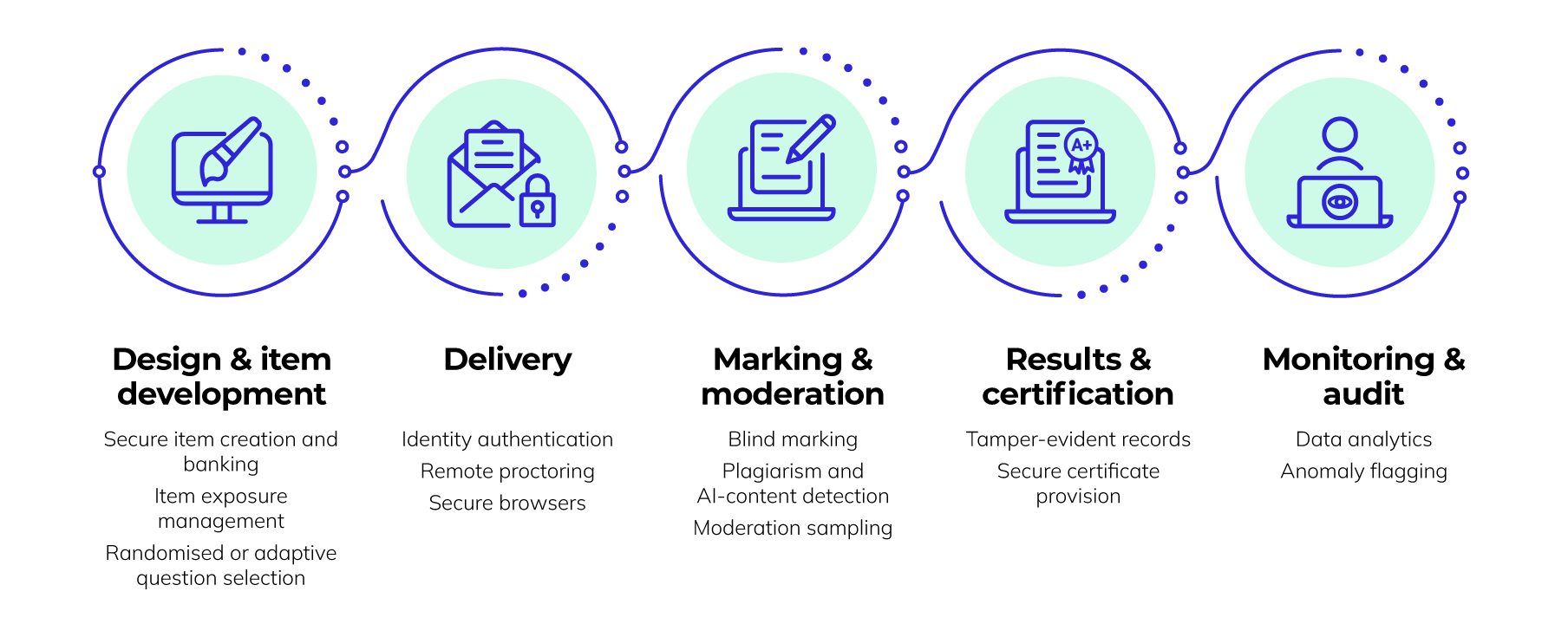
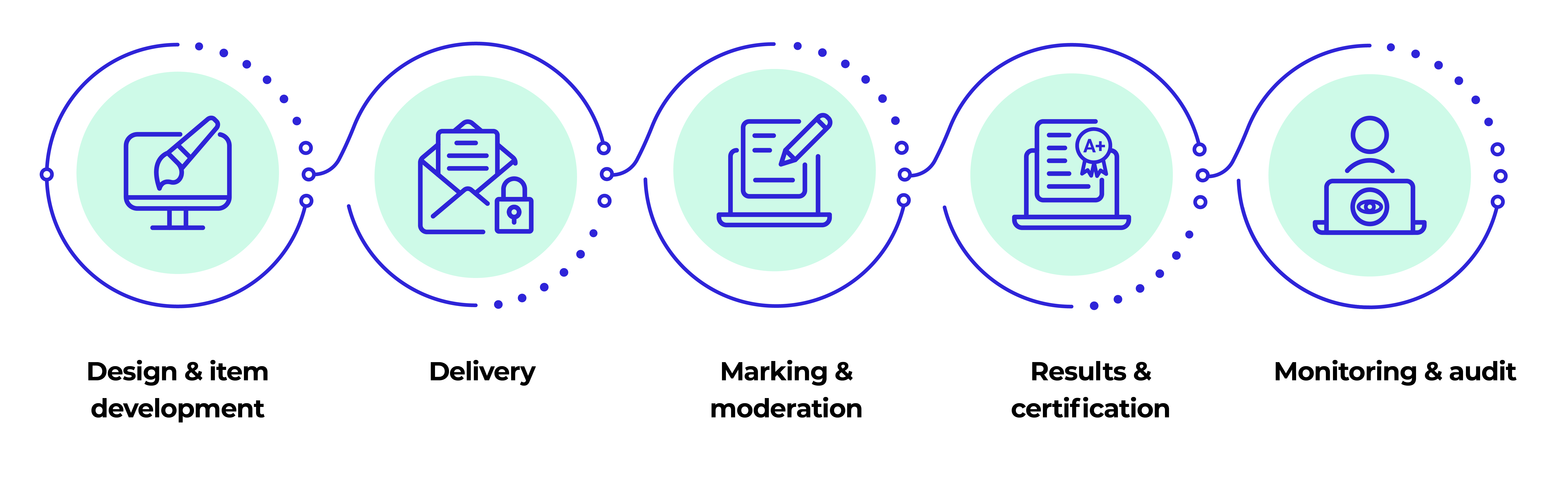

Design and item development
Secure item creation and banking item exposure management randomised or adaptive question selection
Test delivery
Identity authentication remote proctoring secure browsers
The proctoring method chosen is the main contributor to integrity in the test delivery stage. Whether in-person at a test delivery centre or remotely when candidates take the assessment in their own location, it starts with verifying the identity of the person presenting as the candidate. This can happen through human checking of ID credentials. The use of AI tools with human backup or escalation is increasingly common.
Environment checks for remote locations also feature. The remote proctor can require candidates to do a 360-degree scan of their room before starting. This confirms they are alone and have no forbidden materials. During the exam proctors can monitor candidates from multiple angles to reduce cheating and ensure candidates follow requirements. This could include a mobile device behind them, a webcam on their device and live screen sharing.
The test should run in a secure, locked-down browser and limit device functionality to that needed to complete the assessment.
With large-scale testing, whether in-person or remote, digital assessment offers the possibility to identify repeat exam takers. They may be taking the test not to pass, but rather to prepare to impersonate a candidate at a later date or to harvest content.
Balancing candidate experience with integrity in test delivery
The test delivery stage is what largely forms the candidate’s experience of the assessment process. It is therefore crucial to consider how each element intended to increase integrity will impact candidate experience. Any given integrity mechanism may make sense individually but when in combination with the others, could the overall impact be negative for accessibility or convenience.
The proctoring process may reveal an anomaly that could result in a candidate being expelled from the assessment process. An appeals process is optional, but in some cases will be appropriate. The stress of an exam situation can make candidates behave unusually; it does not necessarily mean that they are indulging in malpractice. In remote assessments post-exam analysis of a video feed to compare against the average or typical behaviour for any given candidate is an integrity measure of its own.

Marking and moderation
Blind marking plagiarism and AI-content detection moderation sampling
Integrity depends on consistency and fairness in the marking process. Anonymised candidate answers, clear mark schemes and direction to markers all contribute.
Whether an individual assessment is digital from start to finish or has certain elements conducted digitally, the ability to train markers and then review their work during the marking process will improve integrity. Digital assessment makes the process of marking standardisation easier by providing easy access to sample questions or entire papers. At the same time, senior markers can provide feedback easily and align scoring across a population of markers before the marking of actual exam submissions starts.
To further increase the integrity of marking awarding organisations can include the ability to intervene automatically when using seed questions. Diversion from approved marks can trigger a pause for a specific marker if they appear to need further training or advice.

Results and certification
Tamper-evident records secure certificate provision
The integrity elements of issuing results and credentials differ between general qualifications and professional. Being able to link an issued qualification or certificate back to a completed assessment and ID verification makes for integrity at this stage.
For general qualifications, educational institutions perform a gatekeeping function through their normally longer-term relationship with the candidate. Schools or colleges acting as test centres carry out the responsibilities of entry and exam management for candidates. Awarding bodies rely on these proxies to provide the information that matches a candidate to a set of results, and ultimately a record of achievement. Collective familiarity between candidates and those delivering the assessments helps to give the results and certification process a suitable level of integrity.
The realm of professional qualifications is perhaps more transactional in nature. Candidates can choose their own education provider, maybe switching from one to another at different stages. Professional qualifications confer on candidates a level of specific skills-related knowledge. The ability to continue in professional practice can depend on being able to validate those achievements, making the stakes for confirming the link between and individual and their certification higher. Hard copies with some element of protection against tampering tend to be the preferred choice. However digital communication techniques make this method less certain than in the past.

Ongoing monitoring and audit
Data analytics anomaly flagging
As a mostly inward-facing function, ongoing monitoring and auditing activities make a limited contribution to integrity in digital assessment. However, digital assessment does offer the possibility of collecting and analysing data about the assessment process. Awarding organisations can review data such as:
- Mark distribution among certain cohorts or candidates in certain geographic areas
- Anomalies in the time taken on individual questions
- Similarities in response to certain questions across candidates.
- Variation in outcomes between candidates who choose different locations to take the assessment, such as test centres compared to taking an exam at home.
Design and item development
When creating exam content, using a platform that restricts access to users according to their role will decrease the likelihood of leaks. It should also have the benefit of providing a security audit trail, recording who has created or changed items for the proposed test.
Devising a variety of question formats to include scenario-based questions can help limit candidates’ scope to use standardised answer sets or generative AI tools. In terms of the number of available questions to include in an assessment, the more the better. A large item bank, with randomised question selection provides less scope for content harvesting. Adaptive tests help too in this regard.
Test delivery
The proctoring method chosen is the main contributor to integrity in the test delivery stage. Whether in-person at a test delivery centre or remotely when candidates take the assessment in their own location, it starts with verifying the identity of the person presenting as the candidate. This can happen through human checking of ID credentials. The use of AI tools with human backup or escalation is increasingly common.
Environment checks for remote locations also feature. The remote proctor can require candidates to do a 360-degree scan of their room before starting. This confirms they are alone and have no forbidden materials. During the exam proctors can monitor candidates from multiple angles to reduce cheating and ensure candidates follow requirements. This could include a mobile device behind them, a webcam on their device and live screen sharing.
The test should run in a secure, locked-down browser and limit device functionality to that needed to complete the assessment.
With large-scale testing, whether in-person or remote, digital assessment offers the possibility to identify repeat exam takers. They may be taking the test not to pass, but rather to prepare to impersonate a candidate at a later date or to harvest content.
Balancing candidate experience with integrity in test delivery
The test delivery stage is what largely forms the candidate’s experience of the assessment process. It is therefore crucial to consider how each element intended to increase integrity will impact candidate experience. Any given integrity mechanism may make sense individually but when in combination with the others, could the overall impact be negative for accessibility or convenience.
The proctoring process may reveal an anomaly that could result in a candidate being expelled from the assessment process. An appeals process is optional, but in some cases will be appropriate. The stress of an exam situation can make candidates behave unusually; it does not necessarily mean that they are indulging in malpractice. In remote assessments post-exam analysis of a video feed to compare against the average or typical behaviour for any given candidate is an integrity measure of its own.
Marking and moderation
Integrity depends on consistency and fairness in the marking process. Anonymised candidate answers, clear mark schemes and direction to markers all contribute.
Whether an individual assessment is digital from start to finish or has certain elements conducted digitally, the ability to train markers and then review their work during the marking process will improve integrity. Digital assessment makes the process of marking standardisation easier by providing easy access to sample questions or entire papers. At the same time, senior markers can provide feedback easily and align scoring across a population of markers before the marking of actual exam submissions starts.
To further increase the integrity of marking awarding organisations can include the ability to intervene automatically when using seed questions. Diversion from approved marks can trigger a pause for a specific marker if they appear to need further training or advice.
Results and certification
The integrity elements of issuing results and credentials differ between general qualifications and professional. Being able to link an issued qualification or certificate back to a completed assessment and ID verification makes for integrity at this stage.
For general qualifications, educational institutions perform a gatekeeping function through their normally longer-term relationship with the candidate. Schools or colleges acting as test centres carry out the responsibilities of entry and exam management for candidates. Awarding bodies rely on these proxies to provide the information that matches a candidate to a set of results, and ultimately a record of achievement. Collective familiarity between candidates and those delivering the assessments helps to give the results and certification process a suitable level of integrity.
The realm of professional qualifications is perhaps more transactional in nature. Candidates can choose their own education provider, maybe switching from one to another at different stages. Professional qualifications confer on candidates a level of specific skills-related knowledge. The ability to continue in professional practice can depend on being able to validate those achievements, making the stakes for confirming the link between and individual and their certification higher. Hard copies with some element of protection against tampering tend to be the preferred choice. However digital communication techniques make this method less certain than in the past.
Ongoing monitoring and audit
As a mostly inward-facing function, ongoing monitoring and auditing activities make a limited contribution to integrity in digital assessment. However, digital assessment does offer the possibility of collecting and analysing data about the assessment process. Awarding organisations can review data such as:
- Mark distribution among certain cohorts or candidates in certain geographic areas
- Anomalies in the time taken on individual questions
- Similarities in response to certain questions across candidates.
- Variation in outcomes between candidates who choose different locations to take the assessment, such as test centres compared to taking an exam at home.
Analysing this data can reveal aspects of assessments where the awarding body could improve integrity.
Outside the assessment platform, monitoring social media and other online channels such as Reddit in the pre- and post-exam period could reveal irregularities that need to be addressed.
Integrity in general qualification compared to professional qualifications
The e-Assessment Association recently published the 2026 National Examinations Roundtable Report. One of its conclusions is that:

Integrity is no longer simply about responding to incidents. Increasingly, it depends on anticipating risks, strengthening resilience and preparing for disruption before it occurs."

Integrity in general qualification compared to professional qualifications
The e-Assessment Association recently published the 2026 National Examinations Roundtable Report. One of its conclusions is that:
Integrity is no longer simply about responding to incidents. Increasingly, it depends on anticipating risks, strengthening resilience and preparing for disruption before it occurs."
The report focuses on general qualifications. Professional qualification awarding bodies would no doubt share this view. However, professional qualifications are more likely to be delivered digitally. As a result, the integrity requirements relating to identity verification and preventing candidates from using unauthorised help during exams are more salient.
General qualifications in most countries still rely on in-person invigilation of many candidates. With the prevalence of paper-based exams for general qualifications, technology-based threats are less common. However, professional qualifications use of digital assessments requires measures to secure the device used and prevent candidates from communicating during the exam or gaining access to exam content in advance.
Professional qualification malpractice can carry a very high cost for the candidate, if discovered. Awarding organisations that publish clear expectations of candidate behaviour and set out the consequences of failure to comply generally find it an effective deterrent, especially if the likelihood of detection is correspondingly high.
Integrity failure planning should cover incidents that would involve many candidates such as content leaks, system access issues for candidates or markers/assessors, and uncertainty about the accuracy of marks and grading. In addition, there are the actions of individual candidates trying to seek an advantage. The different candidate profiles in general compared to professional qualification candidates mean that awarding bodies may draw the line between the risk to their assessments and the cost to candidate experience or accessibility of assessments in different places.